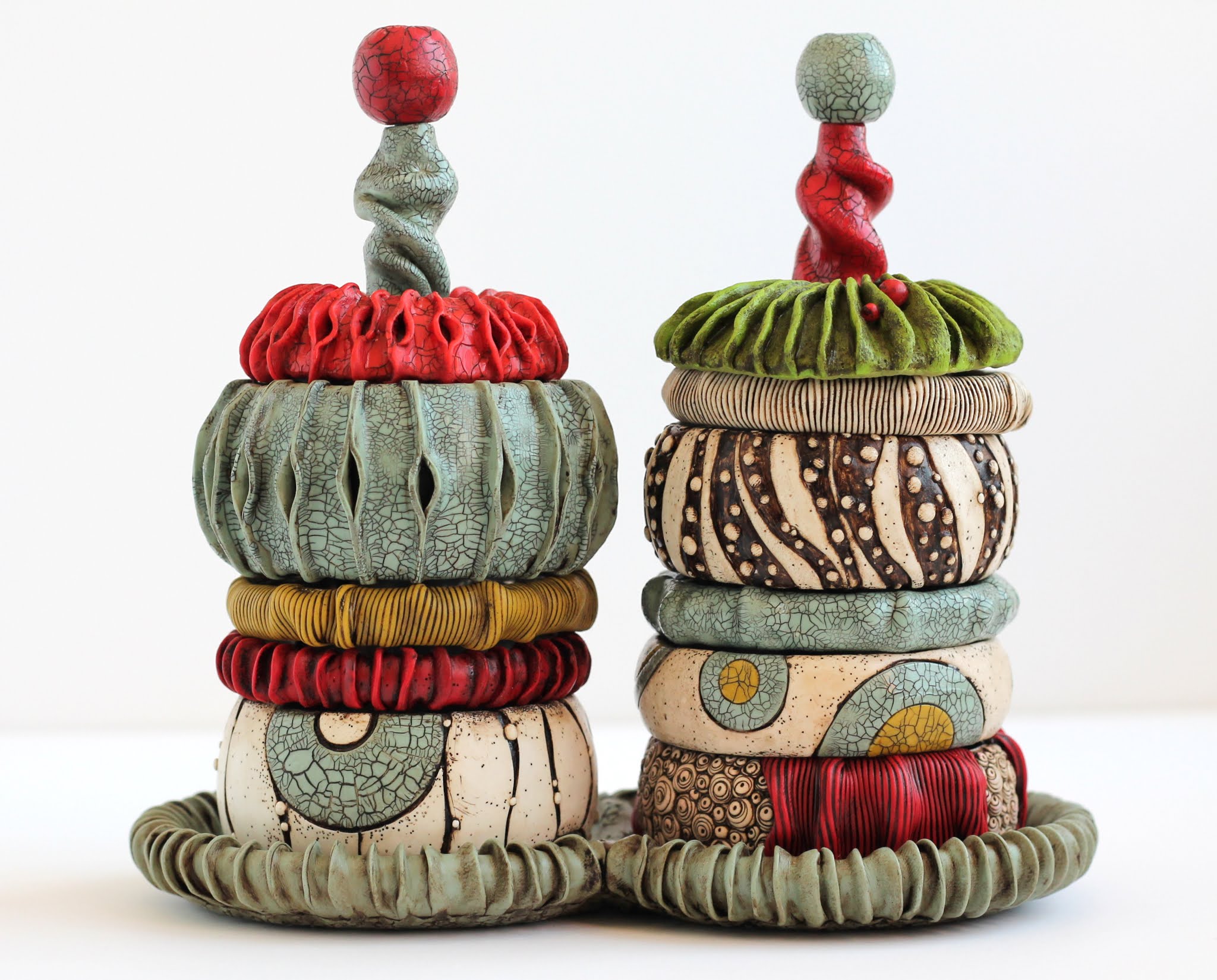
Seguimos con una continuación y también variante de la obra anterior: Cerámica Polimérica
Esta vez enfocada en la bisutería. Uno de los principales atractivos para aquellos amantes tradicionales de la arcilla polimérica.
INSPIRACIÓN
“Joyas Coralinas” es una obra doblemente inspirada:
—De manera predominante o principal, encontramos la fuerte presencia de una naturaleza oceánica en forma de arrecifes y corales marinos. Los corales de arrecife están consideradas como una de las mayores estructuras de la Tierra; además, se cree que contienen el 25% de la biodiversidad del planeta. Y eso que apenas cubren un 0,2% de la superficie. La gran concentración de vida que esplende en ellos, como si se tratara de una eterna primavera, se refleja en sus colores vivos favorecidos por los rayos del sol y las aguas cristalinas, mostrandose así como un conjunto lleno de belleza y creatividad.
—De forma secundaria aunque no menos interesante, la disposición vertical de las piezas y su original presencia no deja de recordarnos a las esculturas talladas en madera que popularmente se atribuyen a los indios de Norteamérica pero que han formado parte de la civilizaciones humanas a lo largo de la historia en diversas partes del mundo. Nos referimos a los Tótems, estructuras verticales que se erigen—entre otras—como símbolo icónico del individuo y que poseen una conexión estrecha, casi mística, con la naturaleza. Es por tanto un símbolo muy personal y característico que expresa de forma artística la unión del individuo con su propia naturaleza o destino.
Esta obra mantiene esa apariencia orgánica y armónica en cuanto a texturas, colores y formas; añadiendo algunos toques personales y característicos de Fabi.
Y no solo seduce por su combinación de colores, lo cuales nos revitalizan de manera casi espontánea con su energía positiva, sino que además incluye una gran variedad de piezas y combinaciones dando lugar a un joyero totalmente único y personalizable.
Por último, la presencia de un par de platos a modo de complemento y que para la ocasión actúan también como alternativa de presentación, son un guiño o reminiscencia ad hoc de la obra `Cerámica Polimérica´
OBRA
La obra al completo esta formada por algo más de 40 piezas.
—4 piezas conjuntas que constituyen una sola base (Collares). (Arcilla polimérica y madera)
—Más de 25 piezas adicionales en forma de piezas sueltas para combinar entre sí. (Arcilla polimérica)
—2 piezas más que forman una segunda base (Broches y pulseras). (Arcilla polimérica y madera)
—4 Broches. (Arcilla polimérica)
—2 Colgantes (Arcilla polimérica)
—9 Pulseras. (Arcilla polimérica y metal)
—2 platos decorativos como alternativa de presentación. (Arcilla polimérica)
Aunque `Joyas Coralinas´ se deriva de la anterior obra: `Cerámica Polimérica´, constituye una técnica en sí misma, pues incluye varios procesos de creación totalmente originales específicamente adaptados a ella.
Se tratan de piezas exclusivamente hechas de arcilla polimérica con la excepción de las pulseras que poseen una armadura metálica y los soportes verticales de ambas piezas compuestas que son de madera.
Todas las piezas—salvo las excepciones mencionadas—se caracterizan por una extraordinaria ligereza ya que han sido creadas de manera que resulten huecas en su interior, para mayor comodidad a la hora de llevarlas puestas, reduciendo su peso final notablemente. Para ello se ha empleado una nueva técnica que Fabi logró descubrir después de varias pruebas y experimentos.
Se trata de una técnica muy divertida con la que aprender a crear texturas originales y jugar con la combinación de colores. Además, se trata de también de una técnica versátil que ofrece gran cantidad de posibilidades. Puede ser empleada como joyero para almacenar broches, collares y pulseras; pero al mismo tiempo puede ser una obra creativa en sí misma compuesta por piezas móviles o intercambiables que logran un conjunto armónico realmente atractivo visualmente. No existen límites para la imaginación, como por ejemplo Fabi demuestra en la combinación de pulseras y broches a modo de cajitas que podéis ver en las fotos.
DETALLES Y ESPECIFICACIONES TÉCNICAS
A continuación, breve descripción de las características técnicas:
-Base de dos piezas unidas entre sí más dos palos de madera (soporte de colgantes, pulseras y broches):
20cm largo-11cm ancho-19cm alto
-Base de cuatro piezas más palos de madera (soporte de piezas sueltas para colgante):
14cm largo-10cm ancho-17cm alto
-Platos: Grande 19cm diámetro; Pequeño 13cm.
-Broches y colgantes de 5 a 9 cm
-Pulseras: 6,5 cm diámetro.
-Cuentas para colgante: De 1,4 a 5cm.
Podéis encontrar más fotos de esta técnica en el blog de Fabi:
Fabi & David
-----------------------------------------------------------------------------------------------
EN
—POLYMER CERAMICS: "Coraline Jewelry”—
Following a continuation and also variant of the previous work:
Polymer ceramics
This time focused on jewelry. One of the main attractions for those traditional lovers of polymer clay.
INSPIRATION
"Coraline Jewelry" is a doubly inspired work:
—Predominantly or mainly, we find the strong presence of an oceanic nature in the form of reefs and marine corals. Reef corals are considered one of the largest structures on Earth, and are believed to contain 25% of the planet’s biodiversity. They barely cover 0.2% of the surface. The great concentration of life that shines in them, as if it were an eternal spring, is reflected in their vivid colors favored by the rays of the sun and the crystalline waters, showing themselves as a set full of beauty and creativity.
—Secondary though not less interesting, the vertical arrangement of the pieces and their original presence does not fail to remind us of the carved wooden sculptures that are popularly attributed to the Indians of North America but that have been part of human civilizations throughout history in various parts of the world. We refer to the Totems, vertical structures that are erected-among others-as an iconic symbol of the individual and that possess a close, almost mystical connection with nature. It is therefore a very personal and characteristic symbol that expresses in an artistic way the union of the individual with his own nature or destiny.
This work maintains that organic and harmonic appearance in terms of textures, colors and shapes; adding some personal and characteristic touches of Fabi.
And not only does it seduce you with its combination of colors, which revitalizes us almost spontaneously with its positive energy, but it also includes a wide variety of pieces and combinations leading to a totally unique and customizable jewelry box.
Finally, the presence of a couple of dishes as a complement and that for the occasion also act as an alternative presentation, are a wink or ad hoc reminiscence of the work `Polymer Ceramics´.
WORK
The entire work is made up of just over 40 pieces.
-4 joint pieces forming a single base (Collars). (Polymer clay and wood)
-More than 25 additional pieces in the form of spare parts to combine with each other. (Polymer clay)
-2 more pieces forming a second base (Brooches and bracelets). (Polymer clay and wood)
-4 Brooches. (Polymer clay)
-2 Pendants (Polymer clay)
-9 Bracelets. (Polymer clay and metal)
-2 decorative plates as an alternative presentation. (Polymer clay)
Although `Coral Jewels is derived from the previous work: `Polymer Ceramics´ , constitutes a technique in itself, as it includes several totally original creation processes specifically adapted to it.
These are pieces exclusively made of polymer clay with the exception of the bracelets that have a metal armature and the vertical supports of both composite pieces that are made of wood.
All the pieces-with the exception of the aforementioned exceptions-are characterized by an extraordinary lightness since they have been created in such a way that they are hollow inside, for greater comfort when wearing them, reducing their final weight significantly. A new technique has been used, which Fabi managed to discover after several tests and experiments.
It is a very fun technique with which to learn to create original textures and play with the combination of colors. In addition, it is also a versatile technique that offers a lot of possibilities. It can be used as a jeweler to store brooches, necklaces and bracelets; but at the same time it can be a creative work in itself composed of moving or interchangeable pieces that achieve a harmonic set really attractive visually. There are no limits to the imagination, as for example Fabi shows in the combination of bracelets and brooches as boxes that you can see in the photos.
DETAILS AND TECHNICAL SPECIFICATIONS
The following is a brief description of the technical characteristics:
-Two-piece base joined together plus two wooden sticks (pendant holder, bracelets and brooches):
20cm long-11cm wide-19cm high
-Four-piece base plus wooden sticks (support for hanging parts):
14cm long-10cm wide-17cm high
-Plates: Large 19cm diameter; Small 13cm.
-Brooches and pendants from 5 to 9 cm
-Bracelets: 6.5 cm diameter.
-Beads for pendant: 1,4 to 5cm.
You can find more photos of this technique on Fabi’s blog:
Fabi & David